
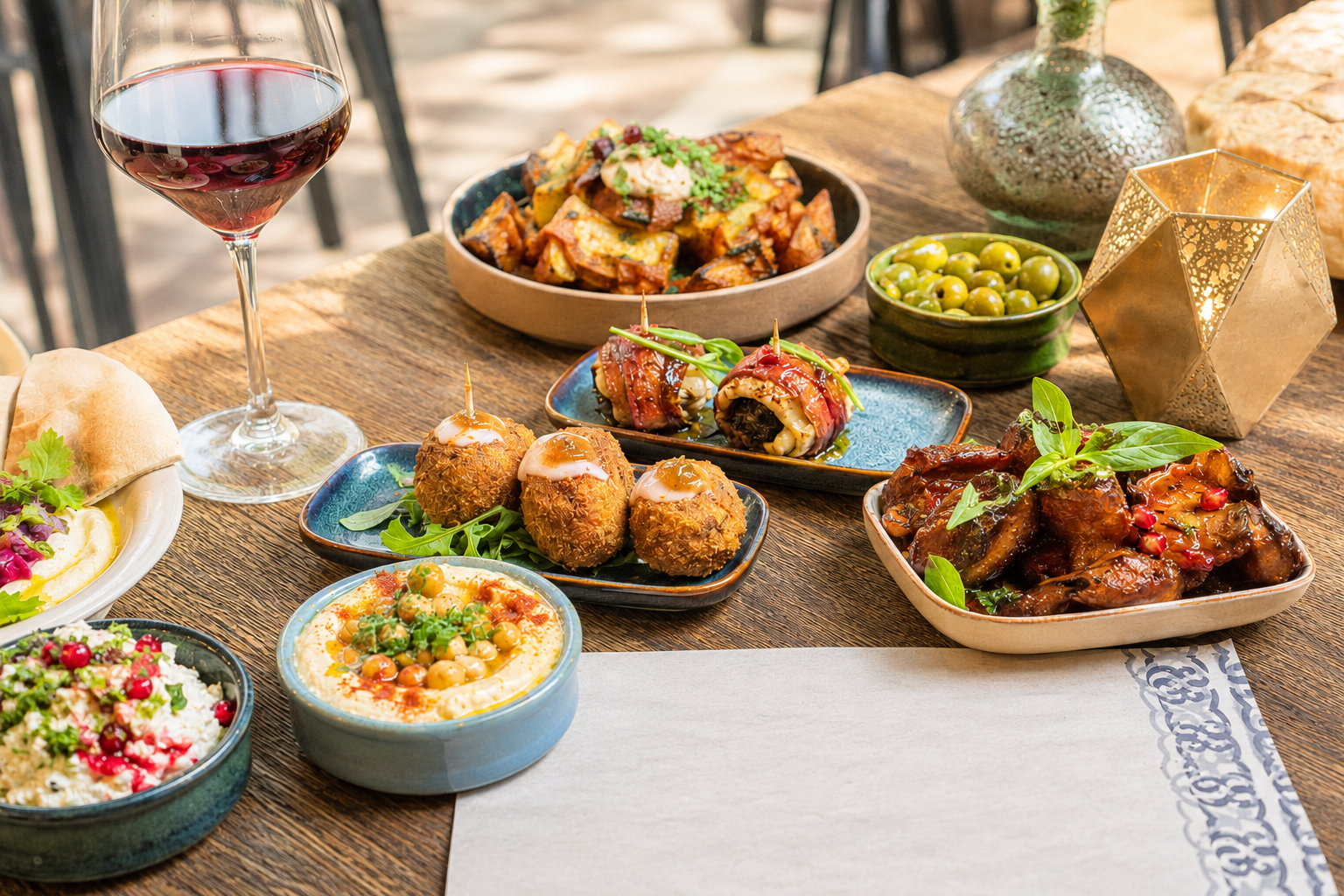
Hummus, babaganoush, falafel, freshly made pitta bread… If you’ve ever eaten at an Arab or Mediterranean restaurant and felt the table filling up on its own with small, colourful dishes, you were probably living a mezze without knowing it. But what exactly is it? How does it resemble our tapas and, above all, how is it different? We’re going to tell you everything.
What is the Arab mezze: much more than a few starters
The word mezze (also written meze or mazza) comes from Arabic and Turkish, and literally means taste or bite. But defining it simply as “starter” would be a serious understatement. Mezze is a whole table philosophy: a shared, slow, social way of eating, deeply rooted in the culture of the Middle East, the Eastern Mediterranean and North Africa.
In countries like Lebanon, Syria, Turkey, Greece, Morocco or Egypt, mezze is not the prelude to the meal: it is the meal. The table is covered with small dishes that arrive all at once or in waves, and diners graze, chat and go back for more with no order or protocol. There is no starter and main course. There are no turns. There is shared abundance.
What dishes usually make up a traditional mezze
The selection varies by country and region, but some of the classics you’ll find on any mezze table are:
- Hummus: chickpea cream with tahini, lemon and olive oil. The most recognised dip in the Arab world.
- Babaganoush: smoked aubergine cream. Smooth, deep, irresistible.
- Muhamara: red pepper, walnut and spice paste. Spicy and addictive.
- Falafel: fried chickpea or broad bean fritters, crispy on the outside and fluffy on the inside.
- Fattoush and tabbouleh: fresh salads with aromatic herbs, tomato and crispy bread.
- Grilled halloumi: the Cypriot cheese that doesn’t melt and wins over everyone who tries it.
- Pitta bread: the foundation of everything — for dipping, wrapping and sharing.
- Dates, nuts and pickles: the sweet and sour counterpoint that balances the table.
What unites all these dishes is not just their size, but their spirit: they are designed to be shared, not eaten alone.
Spanish tapas vs Arab mezze: the real differences
At first glance, tapas and mezze look like close cousins. And in a way they are: both are formats of small-portion food for sharing, both invite socialising and both have deeply rooted cultural origins. But scratch the surface and the differences are considerable.
Origin and cultural context
Tapas were born in Spain, with legends placing their origin in 19th-century Andalusia. Their original logic was to accompany a drink: something small to nibble on while having wine or beer. The act of tapear is a ritual of movement — from bar to bar, standing at the counter, with the city as the backdrop.
Mezze, on the other hand, is born from the culture of Levantine hospitality. In the Arab and Eastern Mediterranean world, welcoming someone into your home or restaurant and filling the table with dishes is a gesture of respect and generosity. You don’t eat standing up or in a hurry. Mezze is the excuse to sit for hours, talk, laugh and connect.
The structure of the meal
- 🇪🇸 Tapas: ordered progressively, often one or two at a time, and can serve as a starter or an entire meal depending on the time of day.
- 🫒 Mezze: everything arrives together, all at once, covering the entire table. The visual abundance is part of the experience.
Flavours and ingredients
The Spanish tapa plays with olive oil, paprika, garlic, cured ham, seafood and local cheese. Its flavour profile is Western Mediterranean: intense, direct, generous.
Arab mezze incorporates a broader palette of spices: cumin, coriander, sumac, zaatar, cinnamon, turmeric, harissa. The flavours are more perfumed, more spiced, with strong sweet-savoury contrasts. Fresh herbs — mint, coriander, parsley — play a starring role that rarely features in the traditional tapa.
The drink that accompanies them
- Tapas: wine, beer, vermouth or a cold draft. The drink is central and the tapa is its companion.
- Mezze: in its most traditional form it is accompanied by arak (Levantine anise spirit), ayran (drinkable yoghurt) or simply lemon water. In contemporary Mediterranean restaurants, also with wines from Lebanon, Morocco or Greece.
What they have in common: the shared soul
Despite their differences, tapas and mezze share something that no gastronomic dictionary can fully define: the conviction that eating well is, above all, eating together. Both formats reject the solitude of the single plate and embrace the idea that the table should be full, that you should try a bit of everything, that ordering too much is always better than not enough.
Both traditions are also the result of centuries of cross-cultural influence. It is no coincidence: during the Middle Ages, the Arab world and the Iberian Peninsula were in permanent contact, and that fusion left its mark on language, architecture and, of course, on food.
Tapas-mezze: the fusion born in the Born neighbourhood of Barcelona
At Ziryab, since we opened our doors in 2012, we have committed to bringing these two traditions together at a single table. It is not a trend or an experiment: it is an idea with centuries of history behind it.
Our tapas-mezze concept is born from the same logic: small dishes, full of personality, designed for sharing. Grilled halloumi with mint and pomegranate vinaigrette. Medjoul dates wrapped in pancetta. Bravas with harissa and black garlic aioli. Caramelised onion falafel with chermoula. Babaganoush with Catalan olive oils.
Local ingredients with Middle Eastern spices. Local techniques with a Mediterranean soul. And a wine list featuring Lebanese, Moroccan, Greek and Catalan wines chosen by our sommelier so that every glass tells a different story.
The result? A table that knows no borders. Exactly as it should be.
Fancy experiencing the tapas-mezze in person? We’re at Carrer de Grunyí 5, tucked away in a narrow alleyway next to the Picasso Museum, in the heart of the Born neighbourhood. Book your table here and let the flavours of the Mediterranean take you on a journey.